
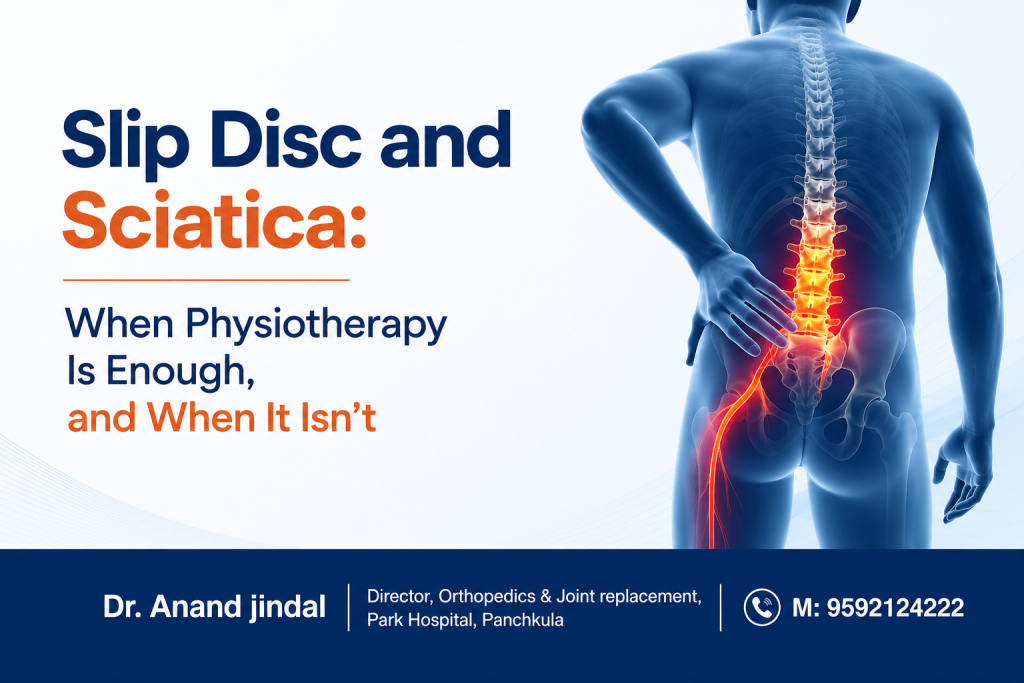
Sciatica has a way of making people panic — that sharp, shooting pain running from the lower back down the leg understandably feels alarming. But here’s something I tell almost every patient: most cases of slip disc-related sciatica don’t need surgery at all.

A slipped (or herniated) disc happens when the soft cushioning between spinal vertebrae bulges or ruptures, sometimes pressing on a nearby nerve root. That pressure is what causes the pain to radiate down the leg, sometimes with numbness or tingling in the foot.
In the majority of cases I see, a structured combination of physiotherapy, anti-inflammatory management, and activity modification resolves symptoms within six to twelve weeks. The body has a genuine capacity to reabsorb disc material over time, and strengthening the surrounding core and back muscles takes pressure off the affected area. That said, there are specific signals that tell me physiotherapy alone won’t be enough, and further evaluation — sometimes surgery — becomes necessary:
Weakness in the leg or foot that’s progressively getting worse, not better Loss of bladder or bowel control (a genuine emergency, requiring immediate care) Pain so severe it isn’t responding to weeks of conservative treatment Numbness that’s spreading or persistent despite therapy If any of these apply, imaging like an MRI helps clarify exactly what’s happening at the disc level, and from there we discuss whether a minimally invasive or stitchless procedure makes sense.
The takeaway I want patients to walk away with: sciatica is common, mostly manageable without surgery, but it deserves a proper diagnosis rather than months of guessing with over-the-counter painkillers.
If sciatica or back pain is affecting your daily life, get evaluated by Dr. Anand Jindal, Director & Head, Orthopedics and Joint Replacement Surgery, Park Hospital, Panchkula.